Who's liable if someone is hurt in your pool? A Naples homeowner's guide
By Nadia Nathan · Updated 2026-07-04
This is general information about pool owner liability in Florida, not legal advice. Liability depends on the specific facts of a situation and can vary by circumstance, so talk to a licensed attorney about your specific situation and insurance coverage rather than relying solely on general guidance like this.
The basic idea behind pool liability
Property owners in Florida generally have a duty to maintain reasonably safe conditions for people lawfully on their property, and pools raise the stakes on that duty because of the real risk of drowning, particularly for young children. Florida’s pool safety barrier law exists specifically to reduce that risk, and courts and insurers alike tend to look at whether a compliant barrier was in place and properly maintained (working self-latching gate, no gaps, alarms functioning if applicable) when a pool-related injury is at issue.
What a compliant barrier does and doesn’t cover
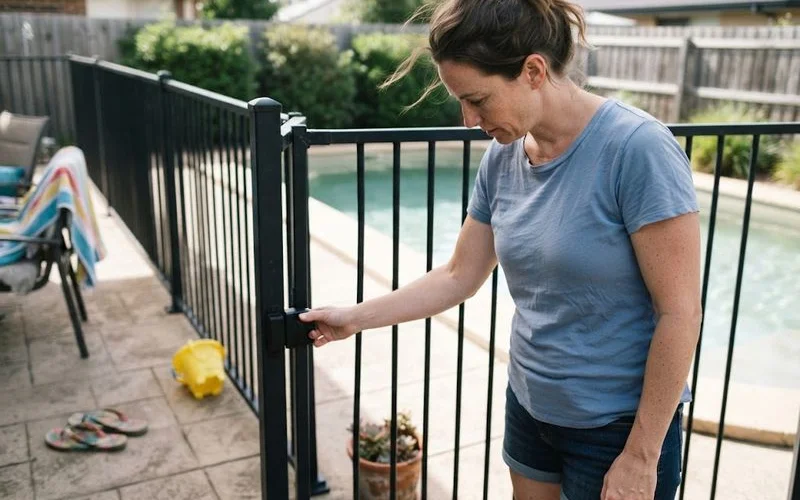
Meeting the legal barrier requirement is a meaningful, concrete step that reduces your risk, both of an incident happening at all and of your exposure if one does. It is not a blanket shield, though. A barrier that’s technically installed but not maintained, a gate propped open, a broken latch left unrepaired, can undercut the protection it was meant to provide. Supervision matters too: a barrier reduces unsupervised access, it doesn’t replace active supervision when children are actually swimming.
| Situation | Liability considerations |
|---|---|
| Compliant barrier, well maintained | Meaningfully reduces exposure, doesn’t eliminate it |
| Barrier present but broken or bypassed | Can undercut the protection the barrier was meant to provide |
| No barrier where one is legally required | Significant exposure, and a code violation on top of it |
| Uninvited child accesses an unfenced pool | Can raise “attractive nuisance” concepts specific to pools |
Practical steps that reduce real-world risk
Beyond the legal minimum, a few habits meaningfully lower your actual risk and, as a side effect, your exposure if something goes wrong. Test the gate latch periodically rather than assuming it still works. Keep pool covers, alarms, or other supplemental safety measures in working order rather than treating them as one-and-done installs. If you host gatherings with children present, designate an adult specifically responsible for watching the water, since “everyone was watching” often means no one specifically was.
Renting out a property with a pool
If you rent out a home or a portion of one with pool access, whether short-term or long-term, liability considerations shift again, since tenants and their guests may have different legal standing than a homeowner’s personal guests. Lease terms, posted pool rules, and confirming your insurance policy actually covers a rental use case (some homeowners policies exclude or limit coverage once a property is rented) are all worth addressing before, not after, you have a tenant.
Insurance is a separate question from liability
Whether your homeowners policy covers a pool-related claim is a distinct question from whether you’re legally liable in the first place, and the two get confused often. Many standard policies include liability coverage, but pools can trigger specific conditions, exclusions, or requirements for additional coverage (an umbrella policy is common advice for pool owners specifically). Read your policy or ask your agent directly whether your pool is addressed, rather than assuming general liability coverage automatically extends to it.
Where to go from here
If you’re building or already own a pool, confirming your barrier is compliant and well maintained (see our guide on Florida’s pool safety barrier law) and having an actual conversation with your insurance agent about coverage are the two most concrete steps available to you. For anything beyond general understanding, particularly if you’re facing an actual claim or a specific concern about your property’s setup, an attorney licensed in Florida is the right resource, not a general guide like this one.
Our home page links to related guides, including buying or selling a home with a pool. See our methodology for how we evaluate and rank the contractors listed in this directory.
FAQ
- Am I automatically liable if someone is injured in my pool?
- Not automatically, liability generally depends on whether you maintained reasonable, code-compliant conditions and whether the injured person was lawfully on your property. This is a legal determination that depends heavily on the specific facts, so this guide is general information, not a substitute for advice from an attorney.
- Does having a compliant safety barrier protect me from all liability?
- A compliant barrier reduces risk substantially and demonstrates you met code, but it doesn't eliminate liability entirely, particularly around supervision, maintenance issues like a broken gate latch, or hazards unrelated to child access.
- Does my homeowners insurance cover a pool-related injury claim?
- Many homeowners policies include liability coverage that can apply, but pools are often specifically noted in policy terms, and some insurers require additional coverage or impose conditions like a compliant fence. Check your specific policy or talk to your agent rather than assuming standard coverage applies.
- What about guests I invite versus someone who wasn't invited?
- Florida law treats these differently, and the legal concept of an 'attractive nuisance' can apply to pools specifically, since they can attract children onto a property even without permission. This is exactly the kind of nuance worth discussing with an attorney if it's a live concern for you.